WebApps Queue Route
The
The
With the Route action, Queue users can route jobs to specific recipients, include additional data like sender name, company name and email address. In addition, the queue user can route the entire document or specific pages and add comments if necessary.
Note:
Using
Additional features enable users to:
-
Edit and annotate jobs before routing them.
-
Route and re-route single jobs.
-
Reassign jobs to other queues.
Before you begin
Administrators must complete the following tasks.
-
Add Route Action (only if you are a current Queue Administrator upgrading to the latest version)
Note: The Route Action is a default action in this release only and becomes available when you set up
You can add the Route action by using Configuration >
Note:
Adding the Route action
To add the Route action
-
Select Configuration >
-
Select the appropriate profile, for example, Default. The Profile Properties dialog box appears.
-
Select the Applications tab.
-
Select the Queue application. The Queue Application Properties dialog box appears.
-
Select the Actions tab.
-
Select Add.
-
Select Route.
-
Specify the General parameters or use the defaults.
-
Select the Options tab.
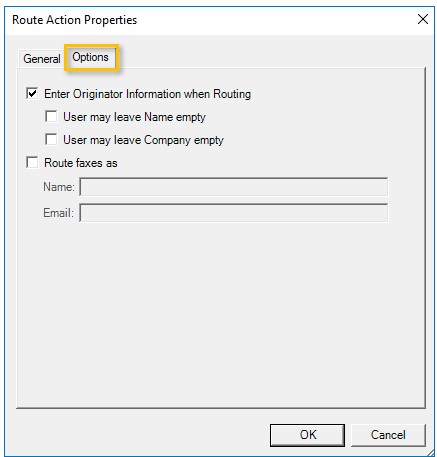
See the Route Action Properties > Options dialog box example below.
-
Select the following options as needed.
How the Enter Originator when Routing option works
|
If selected |
then |
|---|---|
| Yes |
Name and Company data fields appear in the Route Documents dialog box. The User may leave Name and Company empty options become active. If these options are not selected then the Name and Company data fields in the Route Documents dialog box are required to be completed by the Queue user. If both or either of the options are selected then the Queue user can leave the Name and/or Company data fields blank. Note: The name, company, and comments if any are set and used as Cover Page template variables in the following manner.
|
These can be viewed in the Messages In History folder in the Server Administrator. See the Recipient Properties dialog box example below.
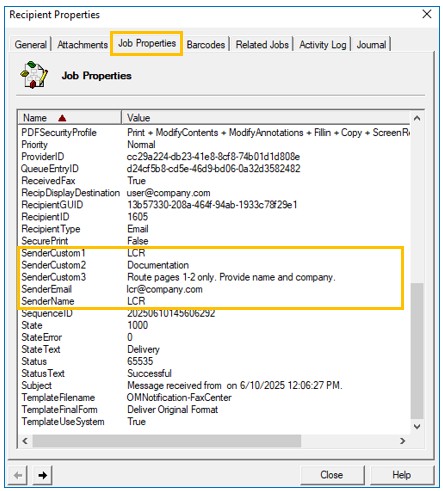
Note: The recipient properties can also be viewed in Search results, In Process queues, and other places.
|
If selected |
then |
|---|---|
| No |
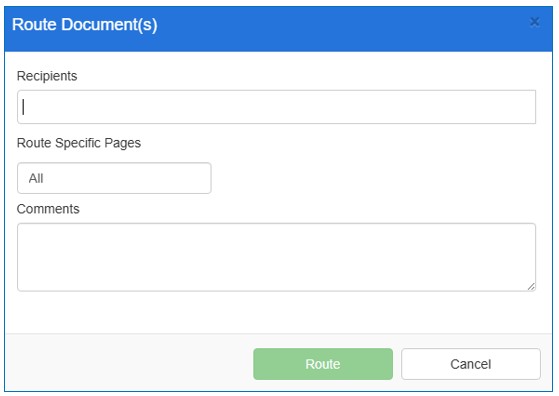
Name and Company data fields do not appear in the Route Documents dialog box. The User may leave Name and Company empty options do not become active and are not applicable. |
-
Enter Originator Information when Routing
-
User may leave Name empty
-
User may leave Company empty
-
With Name and Company data fields
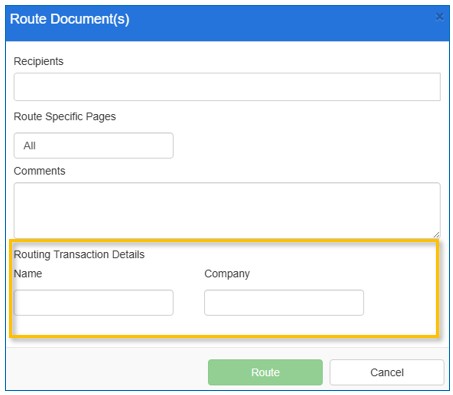
Without Name and Company data fields
Queue user error messages
The following error messages are displayed if the Queue user does not complete the Name and Company data fields when required.
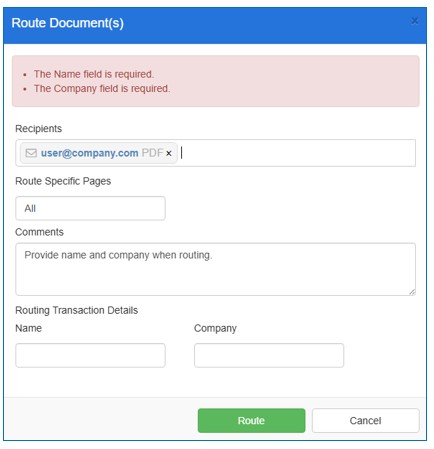
The following error message is displayed if page numbers are specified in a descending order when using the Route Specific Pages field.
-
An invalid page number was specified.
Page numbering must be specified in ascending order. See examples below.
-
In a range, for example, 1-5
-
Separated by commas, for example, 6,9,15
-
Or a combination of both formats, for example, 20-25, 30, 47, 52
How the Route faxes option works
|
If selected |
then |
|---|---|
| Yes |
The new sent message has the Name and Email data fields set into the Cover page template variable in the following manner.
Note: The email is also set as the Originator of the message. |
| No |
The Note: The email is also used and set as the Originator of the message. |
Note: This option applies to all document types that are routed including faxes.
-
Select the following options as needed.
-
Route faxes as
-
Name
-
Email
-
-
Select OK on the Route Actions Properties dialog box.
-
Select OK on the Queue Application Properties dialog box.
-
Select OK on the Default Profile Properties dialog box.