When the Work Item Detailed Auditing option, available under Setup > Work within the Audit Trail settings is turned on, changes made to the Work Items can be tracked and available on the History page to indicate what, when and by whom it was made, including the Linking/Unlinking, Creating and Copying of Linked items. For further details refer to Work Item Detailed Auditing.
- Access the Work Item Entry History
 tab.
tab. Tip: The Work Item History can be accessed either from the Work Item Entry edit page accessed through the Project Edit or the Work Item Manager by either editing the Work Item Entry or by expanding the entry drawer.
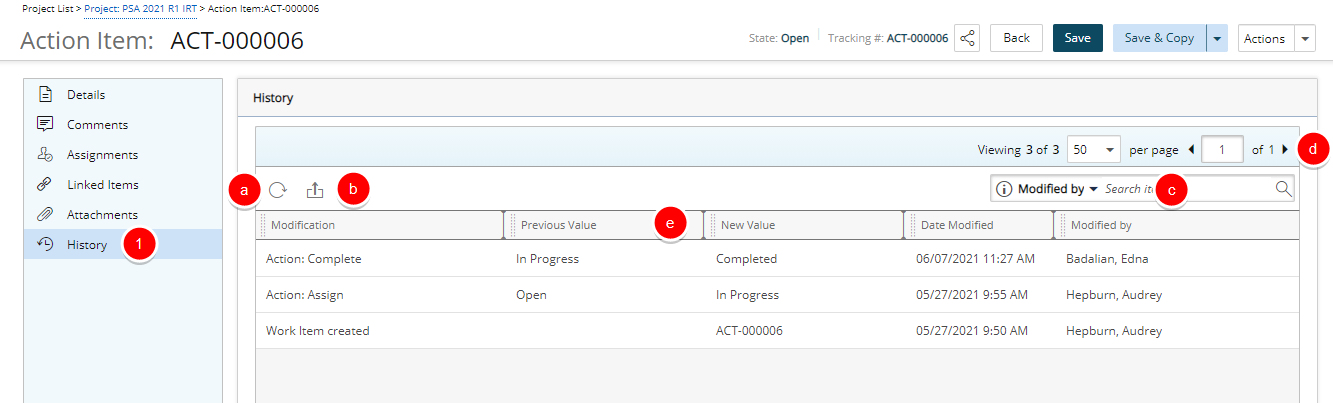
- Regardless of how you accessed the History tab, the following options are available to you:
- Click Refresh
 to refresh the list.
 - Click Export to Excel
 to Export the list to Excel.
 - Click the Search down arrow (
 ), select a criterion and then enter the corresponding value. Then either click the Search
  button or the [Enter] key. The following criteria are available: Modification, Previous Value, New Value, Date Modified and Modified By. For further details refer to Search for an Item.
 - The Pagination facilitates moving to a new History list page and to view the number of History pages. For further details refer to Pagination.
From the table header:
- You can easily sort the columns by ascending or descending order simply by clicking a column header. Note that an arrow indicates the descending (
 ) or ascending (
 ) order applied to the column.
 - Click
 and move a column to the desired position.
 - You can dynamically resize column(s), to your preferred width. Simply move your cursor to the column boundary (
 ) you want to resize. When the cursor becomes a resize cursor, click and drag the column accordingly.
Note: The Deletion of Linked Item(s) such as an Issue associated to a Risk, is only tracked within the Audit Trail and is not displayed within the History tab.
- You can easily sort the columns by ascending or descending order simply by clicking a column header. Note that an arrow indicates the descending (
- Click Refresh